
I remember Ferrymuir before Tesco and Dakota, and estate records and harbour logs together show how quickly steam power, rail infrastructure, and heavy engineering reshaped Queensferry’s shoreline, labour patterns, and civic priorities during the nineteenth century.
This chapter examines the transition from sail to steam, changes to ferry services, harbour adaptations, the arrival and routing of the railway, the establishment of local engineering works, and the social and spatial effects of constructing the Forth Bridge.
Visitor context: The walk from Hawes Pier up to the Forth Bridge is, without much exaggeration, a walk through this whole chapter. The harbour, railway line, bridge approach and waterfront all show how steam, rail and engineering pulled Queensferry out of its old ferry-town shape.
Geography and Physical Setting
Queensferry’s harbour and shoreline imposed clear limits on early industrial change, with shallow approaches, exposed tides, and restricted working ground dictating where steam vessels could berth and where fixed infrastructure could realistically be built.
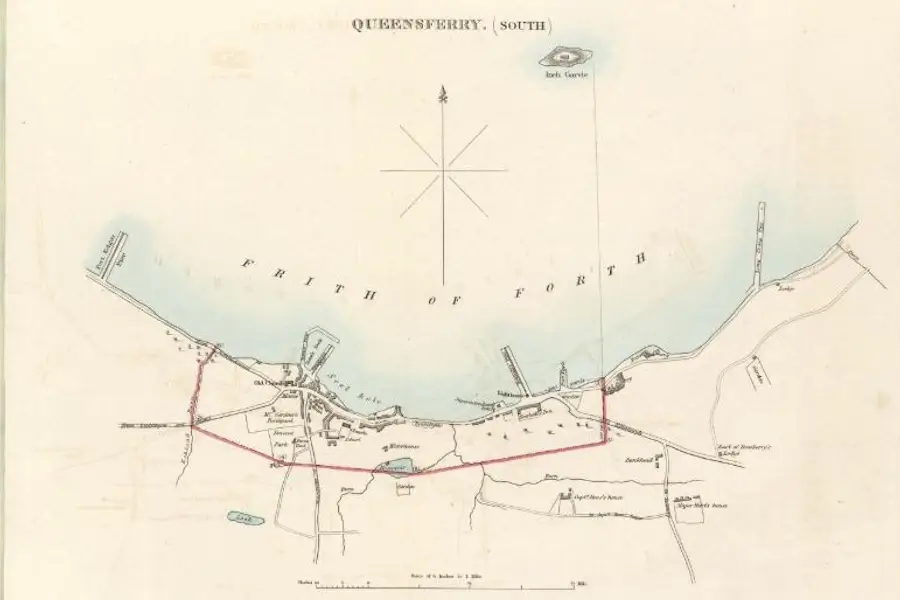
Steamers required deeper water, stronger quays, and predictable access, forcing incremental harbour modifications rather than wholesale reconstruction, and reinforcing the continued use of outer anchorages and tendering where physical constraints could not be economically overcome.
The steep rise behind the harbour concentrated workshops and storage on available terraces and slopes, shaping where engineering sheds, material yards, and later railway alignments could be placed without destabilising existing housing or access routes.
Work, Trade and Daily Movement
The introduction of steam ferries altered daily rhythms, reducing reliance on wind and tide while increasing timetable discipline, ticketing systems, and mechanical maintenance demands previously unknown in the sail-dominated ferry economy.
Ferry crews expanded to include engineers, firemen, and maintenance staff, while local trades adapted to support coal supply, boiler repair, and vessel servicing, drawing skilled labour into the town from surrounding districts.
Passenger movement increased in regularity rather than volume, reinforcing Queensferry’s role as a controlled crossing point rather than a free-flowing port, with movement shaped by schedules rather than opportunity.
Evidence from Local Archives
Harbour records and estate papers from the nineteenth century show repeated small-scale works to strengthen quays, improve landing stages, and accommodate steam vessels without altering the harbour’s fundamental layout.
These documents reflect financial caution, with expenditure tightly linked to ferry revenue and regional demand, rather than speculative expansion, suggesting local authorities prioritised continuity over transformation.
Correspondence relating to ferry leases highlights tensions between operators and civic bodies over maintenance responsibility, safety standards, and investment timing as mechanical complexity increased operational risk.
Movement of Goods and People
The arrival of the railway altered freight movement patterns more than passenger behaviour, diverting bulk goods away from small vessels and reducing the harbour’s role in regional distribution networks.
Rail sidings and depots handled coal, building materials, and industrial supplies more efficiently, while the harbour increasingly served local needs, ferry traffic, and specialist uses rather than general commerce.
This shift reduced dockside labour demand but increased employment linked to rail handling, maintenance, and administration, subtly rebalancing the town’s working population without immediate population growth.
Regional and National Influences
National railway expansion plans placed Queensferry within a strategic corridor rather than as a destination, shaping line routing decisions that prioritised through-movement over local access convenience.
Government-backed infrastructure investment brought external engineers, surveyors, and contractors into the town, introducing unfamiliar working practices, wage structures, and hierarchical labour organisation.
These influences diluted purely local control over development decisions, embedding Queensferry within national transport planning frameworks that increasingly overrode local preference or tradition.
Early Industries and Local Economy
Engineering works established behind the Hawes Inn provided fabrication, repair, and assembly capacity linked to railway and bridge construction demands rather than local consumer markets.
These yards employed large numbers of itinerant workers alongside resident tradesmen, creating temporary population pressures and altering housing usage through lodging arrangements and short-term tenancies.
Local businesses benefited unevenly, with food, drink, and basic services seeing increased demand, while traditional crafts not aligned with heavy engineering experienced relative decline.
What the Records Show
Contemporary accounts and administrative records show sustained concern over safety, crowd control, and accommodation during peak construction periods, particularly as bridge works intensified.
Local authorities negotiated responsibilities for road upkeep, policing, and sanitation, reflecting the strain placed on infrastructure designed for a smaller, more stable population.
These records reveal a town managing disruption pragmatically rather than celebrating progress, focused on containment and order rather than symbolic civic expansion.
External Forces Shaping Queensferry – The Forth Bridge Construction

Construction of the Forth Rail Bridge from 1883 to 1890 dominated Queensferry’s physical and social environment, introducing unprecedented industrial scale through massive cantilever structures, deep-water foundations, and continuous heavy material movement across land and shore.
Thousands of workers were employed directly and indirectly, with fabrication yards, staging areas, and access routes concentrated around the Hawes Pier area and adjacent slopes, reshaping circulation, noise levels, housing demand, and local authority responsibilities throughout the construction period.
Design decisions reflected lessons from the Tay Bridge disaster, resulting in extreme over-engineering, duplicated load paths, and extensive testing, producing a structure whose scale, weight, and permanence permanently altered how Queensferry was perceived within national transport networks.
Setting the Stage for Later Growth
The completion of the Forth Bridge in 1890 permanently altered movement patterns, reducing ferry dependence while reinforcing Queensferry’s identity as an engineering landmark rather than a transport bottleneck.
Rail connectivity integrated the town more firmly into regional commuting and supply networks, laying groundwork for later residential growth and professional employment beyond traditional maritime trades.
Much of this industrial reshaping remains visible from the slopes above Hawes and along the shoreline. The bridges dominate the horizon in a way that makes the engineering legacy difficult to ignore.
The Age of Engines marked a transition from locally driven adaptation to externally directed change, setting conditions that defined Queensferry’s twentieth-century development trajectory.
Queensferry History Companion (Chapters)

A chapter-by-chapter historical reference
- Chapter 1 – Before Queensferry
- Chapter 2 – The Birth of the Ferry
- Chapter 3 – The Making of a Medieval Settlement
- Chapter 4 – Burgh Rights
- Chapter 5 – Turbulent Times
- Chapter 6 – 1700s Prosperity
- Chapter 7 – The Industrial Rise of The Ferry
- Chapter 8 – Steam, Railways, the Coming of the Bridges
- Chapter 9 – Queensferry in Wartime
- Chapter 10 – Modern Queensferry
Map Image: CC-BY via NLS Here
Bridge Image: CC-BY via NLS Here