This appendix gathers material that supports my Queensferry History Guide without interrupting its chapters – shared language, working terms, and customs that endured after industries faded and buildings changed.
Visitor context: This history companion gives background to the places, routes, buildings, harbour, bridges, and traditions mentioned across Queensferry.net’s visitor guides. Start here if you want the deeper story behind South Queensferry before planning your walk, cruise day, or bridge viewpoints.
Glossary of Queensferry Terms
Bink: A bench, bank, or shelf; in Queensferry often referring to rock shelves or shoreline landings.
Braes: Hills, in Queensferry these are the steep slopes running down behind the High Street toward the shore, shaping movement and limiting later street development. Referred to as the Back Braes.
Close: An enclosed place; a narrow passage leading off a street, often giving access to yards, rigs, or secondary housing.
Corbel: A method of building out in stepped stone projections to support weight above.
Croft: A piece of arable land attached to a dwelling.
Crowstep: A stepped gable, common in Scots domestic architecture.
Dook: A Scots verb meaning to dip, bathe, or briefly submerge in water, often used informally. In Queensferry, the Loony Dook occurs every New Year’s Day, where participants dook in the Forth. The term loony is short for ‘lunatic’.
Dormer: A projecting roof window or room; from the French dormir, meaning “to sleep”.
Feu: A Scots system of land tenure where the holder makes payment in money or kind in return for perpetual use of land or buildings.
Gate (Gait): A way, path, or street.
Harling: A roughcast wall finish used for weather protection.
Hawes: The ferry landing and harbour area at the western end of the town; historically the working heart of crossing traffic.
Kirk Session: The governing body of the parish kirk, responsible for discipline, welfare, and local order.
Land: A building; Scots usage.
Lang Rig: A long, narrow strip of land extending back from the High Street, defining status, property boundaries, and later building patterns.
Lintel: A structural stone set above a doorway or window.
Loan: An open space or passage left between fields; in Queensferry, later applied to a principal road leading out of town. In Queensferry, The Loan is the steep hill from the Primary School to the junction of the High Street and Hopetoun Road.
Lum: A chimney. In Scots there’s a saying Long may your lums reek. In other words, may you have prosperity so you always have coal to heat your home.
Marriage Lintel: A carved stone set above a doorway bearing the initials of the first occupants and the date of construction.
Rig: A ridge or strip of land.
Skewputt: A stone at the eaves of a roof, often decorative or carved.
The Ferry: Local shorthand for South Queensferry itself, still used in everyday speech. “I’m goin’ doon the ferry” – “I’m going to go to the High Street”
The Roads: An offshore anchorage where ships lay at moorings rather than entering harbour.
Tolbooth: The burgh’s administrative and judicial building, incorporating council functions, detention space, and the public clock.
Vennel: A narrow lane. The Auld Kirk in Queensferry is located on The Vennel.
Wynd: A narrow alley in a town.
Queensferry Traditions and Customs
Despite its size, Queensferry has maintained a set of customs found nowhere else in Scotland, shaped by isolation, continuity, and a town accustomed to marking time in its own way.
The Burryman
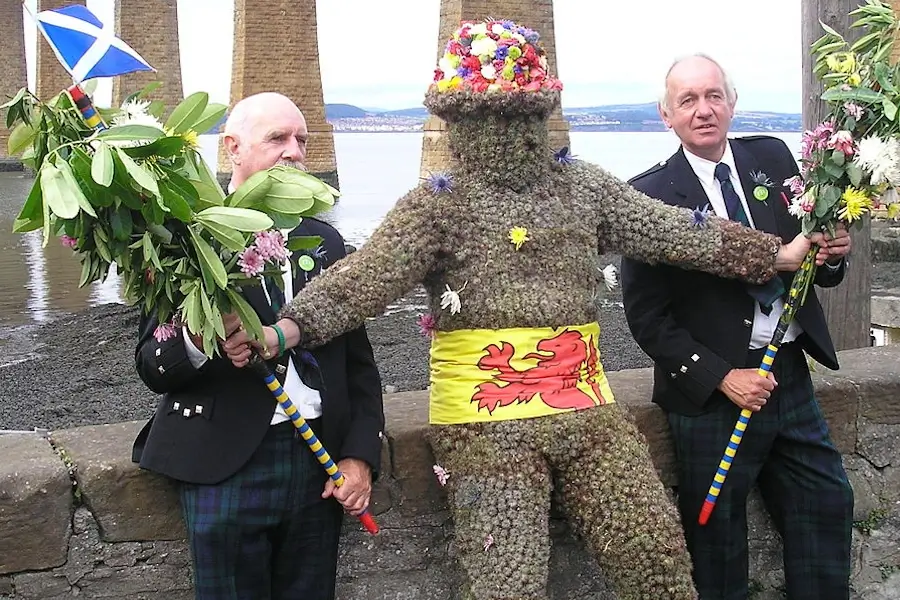
Held annually during the Ferry Fair, the Burryman ritual involves a local man covered head to toe in burdock burrs, escorted through the town. Its origins remain uncertain, but the form has changed little. The emphasis has always been endurance, continuity, and community involvement rather than spectacle.
The Ferry Fair
Queensferry’s oldest civic celebration is rooted in medieval market rights and trade gatherings from the 12th century. Once tied closely to commerce and harbour activity, it evolved into a broader town festival. Despite changes in scale and format, it remains a marker of local identity rather than a visitor event.
The Loony Dook
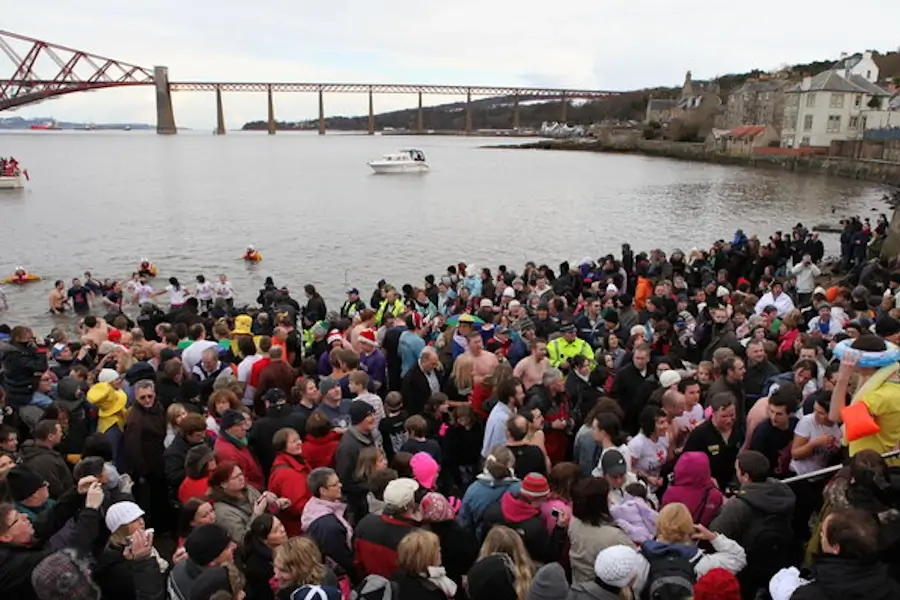
Held on New Year’s Day, the Loony Dook involves participants plunging into the cold waters of the Firth of Forth, often in costume. The name combines loony and the Scots word dook, meaning to dip or bathe.
The event began in 1986 as a joking suggestion by local residents as a hangover cure, becoming a charity event the following year. For many years it was organised informally by locals, using nearby pubs for access and changing.
As crowds grew, the Loony Dook was absorbed into the official Edinburgh Hogmanay programme in 2011, with formal management, entry fees, and safety controls introduced. While it now attracts international visitors, its origins remain firmly local, rooted in Queensferry humour and winter hardiness.
Continue Exploring Queensferry
Queensferry History · Things to Do in South Queensferry · Queensferry Walking Tour · Where to Eat in South Queensferry
Hero Image: CC-BY via NLS
Picture: The Burryman Michael Mabbott, CC SA 3.0 via Wikimedia Commons.
Picture: The Loony Dook in the Firth of Forth Calum McRoberts, CC SA 2.0 via Wikimedia Commons.